




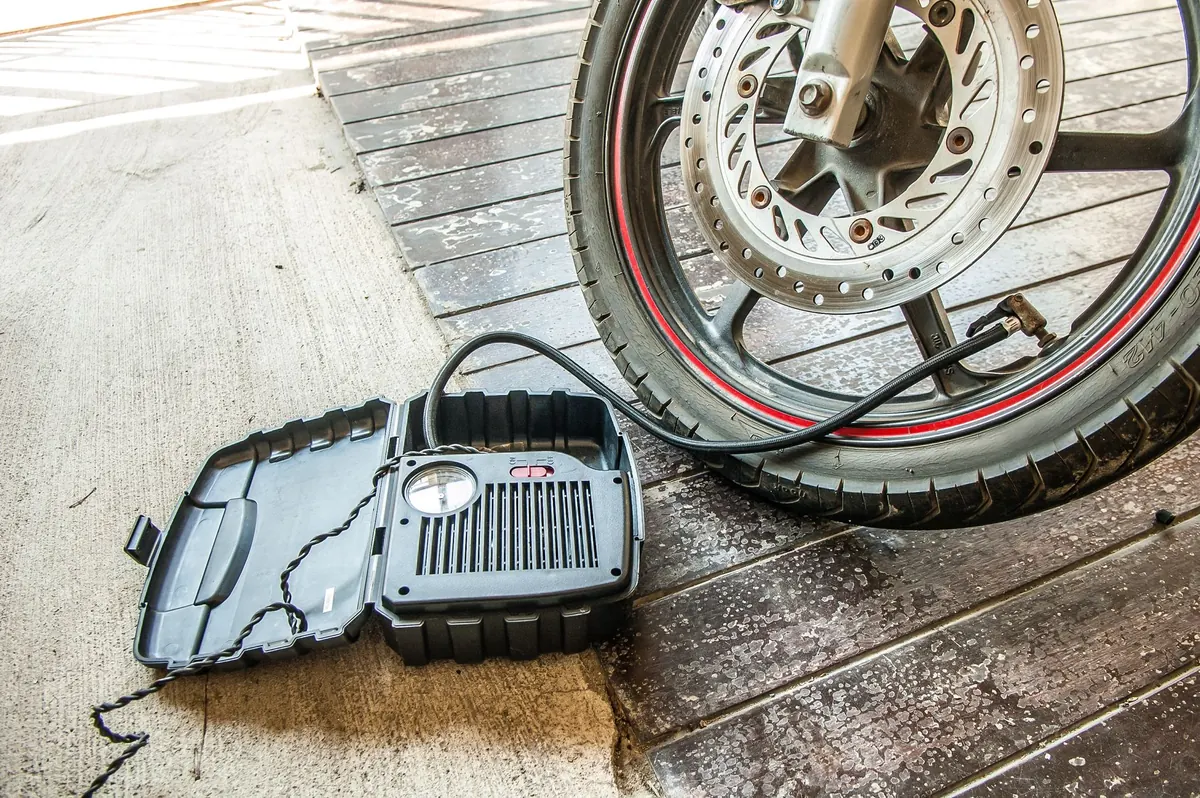
Small cars are gentle on tires in one sense: there's less weight to carry. They're demanding in another. With a smaller contact patch and modest recommended pressures, a tire that's a few pounds off makes itself known quickly — vague steering, longer stops, and a fuel bill that creeps upward. Fifteen minutes a month with a gauge and a tread check covers almost everything that matters.
Use the Door Jamb, Not the Sidewall
The big number molded into a tire's sidewall is the maximum pressure it can safely hold at its rated load. It is not a recommendation for your car. The number you want is on the placard inside the driver's door jamb, and sometimes under the fuel flap or in the glovebox. It lists front and rear pressures separately, and often a higher figure for a fully loaded car or sustained high-speed driving.
That distinction matters more on a light car than most owners expect. If the placard calls for 32 psi and you're running 28, you're more than ten percent low — enough to soften turn-in and add rolling resistance. Check the spare too. A temporary space-saver often wants a much higher pressure than the road tires, and it will quietly go flat over a couple of years if nobody looks at it.
How to Check Pressure So the Number Means Something
Pressure is only comparable when the tire is cold. Cold means the car has been sitting for at least three hours, or you've driven less than a couple of miles at low speed. A tire warmed up on the highway can read several psi higher than it did in the driveway. That's normal physics, not a fault, and it's not a reason to bleed air out of a warm tire.
The procedure
Unscrew the valve cap, press the gauge squarely onto the valve, and take a reading. If you need to add air, do it in short bursts and recheck — it takes less air than you think to move a pound or two. A cheap digital gauge is easier to read than a pencil gauge, but either beats guessing.
Two habits are worth building. Replace missing valve caps; they keep grit and moisture out of the valve core, which is where slow leaks usually begin. And don't treat the dashboard warning light as a pressure check. Most systems only trigger when a tire is roughly a quarter below the recommended pressure — well past the point where handling and economy have already suffered.
Temperature is a pressure adjustment
Air contracts as it cools. As a rough rule, a tire loses about 1 psi for every 10°F (about 5.5°C) drop in ambient temperature. A car that sat at 70°F in autumn and now sits at 30°F has quietly lost around 4 psi — often enough to trip a warning light on the first cold morning, and plenty to matter.
A tire can be twenty percent low and still look perfectly normal. The gauge is the only honest answer.
Reading Tread Depth
New tires typically start with around 10/32 inch of tread. The legal minimum in most places is 2/32 inch (1.6 mm), but that is a floor, not a target. Wet grip fades well before you reach it, and a light car still has to clear standing water. Many drivers replace at 3/32 or 4/32 inch, and winter tires are usually retired nearer 4/32 because their snow bite depends on deep tread.
You don't need to memorise numbers to catch a worn tire. Every tire has raised wear indicators — small bridges across the grooves at 2/32 inch. When the tread sits flush with them, the tire is finished. A simple tread depth gauge costs very little and takes ten seconds.
Measure in more than one place
Check the outer shoulder, the centre, and the inner shoulder, and do it at three points around the circumference. A tire that's fine in the middle and bald on one edge is telling you something before it turns into a handling problem.
What Your Wear Patterns Mean
- Worn in the centre, shoulders still deep: long-term overinflation. The tire has been riding on a narrow strip.
- Worn on both shoulders, centre still deep: long-term underinflation, usually paired with a soft, floaty feel.
- One shoulder worn, the other fine: too much camber, or a bent suspension component. Have the alignment checked.
- Cupped, scalloped, or patchy dips around the tread: worn dampers, tired bushings, or a wheel out of balance. Light cars feel tired dampers sooner than heavy ones.
- Feathered or diagonally stepped tread blocks: a toe alignment problem.
- One tire much more worn than the rest: a missed rotation, or a brake caliper that's dragging.
- Flat spots: a hard stop with locked wheels, or a car that sat in one place for months.
While you're down there, run a hand along each sidewall and look for bulges, cuts, cracks, and embedded screws or nails. A bulge means internal cord damage. That tire should come off the car, not get topped up with air and driven on.
Rotation, Balance, and Alignment
On a front-wheel-drive small car, the front tires do most of the work: they steer, they carry the braking bias, and they put the power down. They will wear faster, and rotating evens that out. Aim for every 5,000 to 8,000 miles (roughly 8
Photo: Srattha Nualsate / Pexels
Related posts
More stories you’ll love reading